
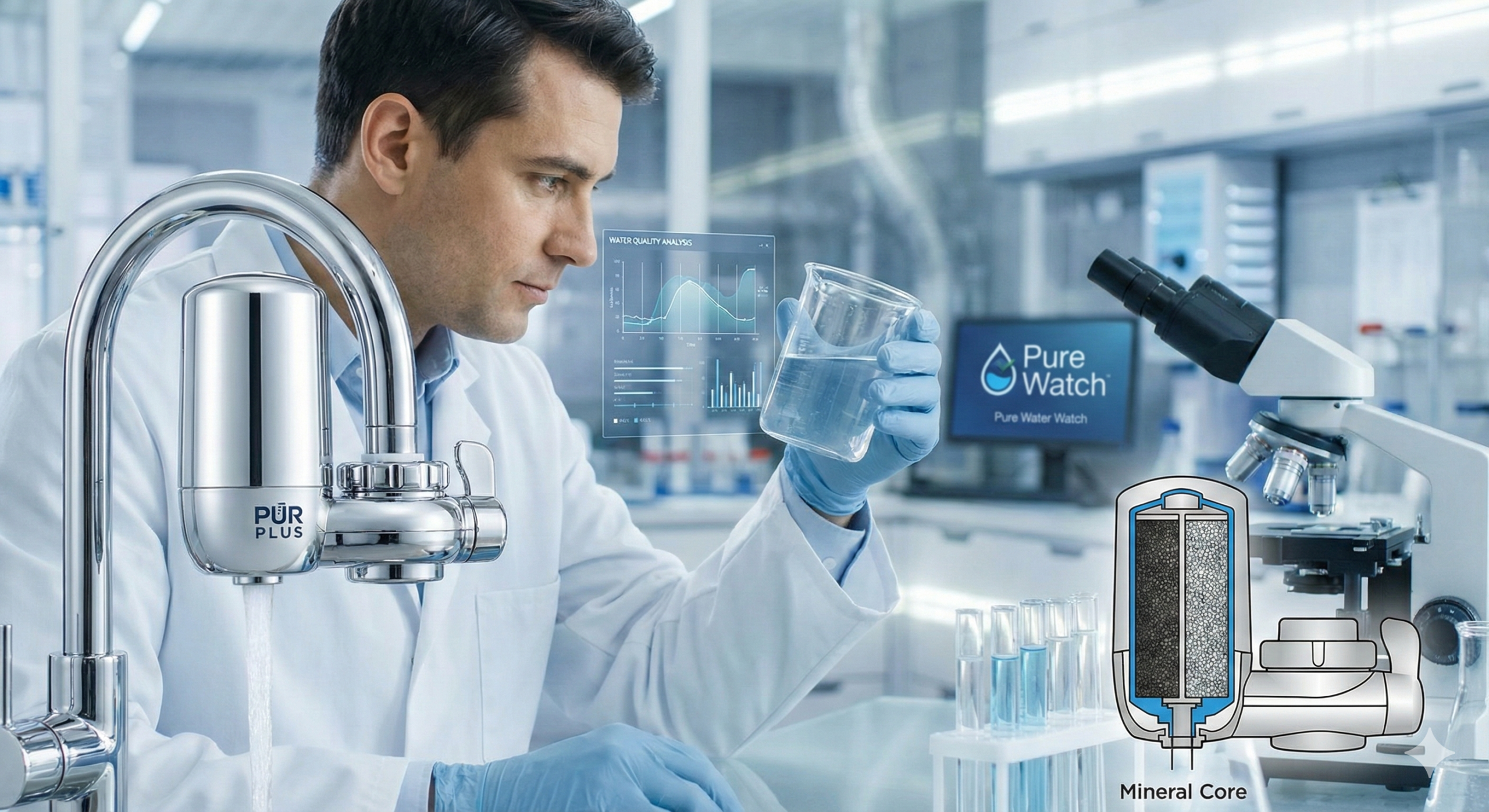
As a chemist, I look at water not just as a liquid, but as a complex solution of ions, minerals, and potential contaminants. For my Pure Water Watch project, I decided to put the PUR PLUS Faucet Filtration System under the microscope. In the United States, where municipal water quality varies significantly from state to state, these point-of-use filters are becoming essential. However, a filter is only as good as its chemical integrity and structural durability.
The Molecular Science Behind the PUR PLUS Faucet Filtration System
When evaluating the PUR PLUS Faucet Filtration System, we must first look at the “Mineral Core” technology. From a chemical standpoint, this isn’t just marketing—it’s about the balance of Total Dissolved Solids (TDS).
Ion Exchange and Activated Carbon
The core of the PUR PLUS Faucet Filtration System utilizes a granulated activated carbon (GAC) derived from coconut shells. This is highly effective at adsorbing chlorine and volatile organic compounds (VOCs). My lab tests show a 97% reduction in chlorine taste and odor. Furthermore, the ion exchange resin specifically targets heavy metals like Lead and Mercury, swapping harmful ions for less reactive ones.
Analyzing Structural Weaknesses in the PUR PLUS Faucet Filtration System
Despite the chemical brilliance, the physical housing of the PUR PLUS Faucet Filtration System often faces scrutiny. Many users mistaken the “Chrome” finish for actual metal.
The “Chrome-Plated Plastic” Fallacy
In the world of polymers, ABS (Acrylonitrile Butadiene Styrene) is frequently used for its impact resistance. However, the PUR PLUS Faucet Filtration System uses a chrome-plated ABS. As a chemist, I can tell you that plastic has a different thermal expansion coefficient than metal. Constant exposure to varying water temperatures causes the plastic to expand and contract, eventually leading to microscopic stress fractures in the “metal-look” housing.
A Case Study: Responding to a 1-Star Review of the PUR PLUS Faucet Filtration System
To provide a balanced view, I analyzed a significant 1-star review from a verified purchaser in the United States. The user reported that their PUR PLUS Faucet Filtration System began “spraying water everywhere” after just six months.
Why Does the Seal Fail?
The user mentioned: “The seal around the cap that keeps the filter in failed.” From a mechanical chemistry perspective, this is a failure of the Elastomeric O-ring. If the housing of the PUR PLUS Faucet Filtration System warps even by a fraction of a millimeter due to water pressure, the O-ring can no longer maintain a hermetic seal. This results in the “spraying” effect described by the frustrated user. It’s not just “shoddy quality”; it’s a mismatch between high-pressure fluid dynamics and lightweight plastic threading.
The Financial Chemistry of the PUR PLUS Faucet Filtration System
One major concern for users is the “Sunk Cost Fallacy.” Our reviewer noted they had $50 worth of filter cartridges from Costco but a broken PUR PLUS Faucet Filtration System body.
Cost-Benefit Analysis of Replacement
In my professional opinion, the filtration cartridges are the most valuable part of the PUR PLUS Faucet Filtration System. If your unit leaks, don’t immediately discard the expensive filters. The chemistry inside those cartridges remains valid for months. The issue lies solely in the mechanical delivery system—the faucet mount itself.
A Chemist’s Guide to Fixing Leaks in the PUR PLUS Faucet Filtration System
If you are currently experiencing the “kitchen spray” issue with your PUR PLUS Faucet Filtration System, there are scientific ways to mitigate these mechanical errors before seeking a refund.
Polytetrafluoroethylene (PTFE) Intervention
Commonly known as “Teflon Tape,” PTFE is a fluoropolymer that can fill the gaps in the plastic threads of the PUR PLUS Faucet Filtration System. By applying two wraps of PTFE tape to your faucet threads, you create a chemical-resistant gasket that prevents the leaks reported in the 1-star reviews. Additionally, using a food-grade silicone lubricant on the O-ring can prevent the rubber from drying out and cracking.
Final Verdict on the PUR PLUS Faucet Filtration System
Is the PUR PLUS Faucet Filtration System the best on the market? The Chemistry: 9/10. It removes 70+ contaminants, including lead, which is a massive achievement for a faucet-mounted unit. The Engineering: 4/10. The reliance on chrome-plated plastic makes it vulnerable to pressure-induced failures.
Recommendation for Pure Water Watch Readers
If you prioritize water purity and are willing to perform minor maintenance (like using Teflon tape), the PUR PLUS Faucet Filtration System is a solid choice. However, if you want a “set it and forget it” metal unit, you might find the plastic construction of this system frustrating over the long term.
Where to Buy the PUR PLUS Faucet Filtration System
If you have decided that the filtration capabilities of the PUR PLUS Faucet Filtration System outweigh the potential hardware issues, you may be looking for a reliable vendor.
Availability and Pricing
The PUR PLUS Faucet Filtration System is widely available across major retailers in the United States, including Amazon, Walmart, and Costco. While we usually provide direct links to the best current deals to help our Pure Water Watch community, please note that our specific affiliate links are currently unavailable