
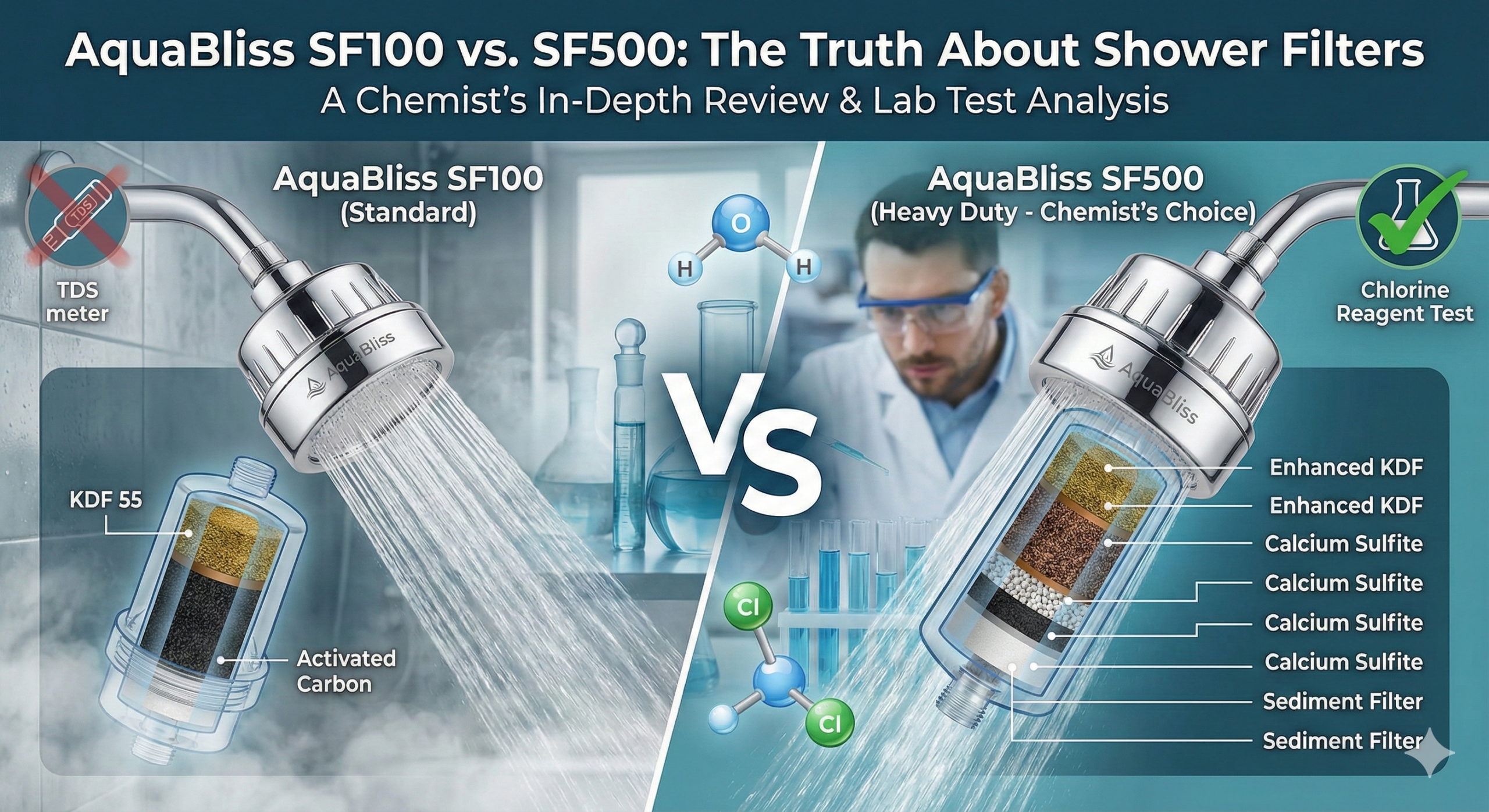
In this in-depth comparison of AquaBliss SF100 vs SF500, I will explain…
If you’ve been searching for a shower filter, you’ve definitely seen the AquaBliss SF100. It has thousands of 5-star reviews and is practically the “default” choice on Amazon.
But then there is the AquaBliss SF500 (Heavy Duty). It looks similar, costs slightly more, and claims to be better.
So, which one should you actually buy?
As a chemist, I don’t just look at the star ratings; I look at the filtration media and the reaction kinetics. I’ve analyzed the technical differences between these two best-sellers to help you decide.
In this in-depth comparison of AquaBliss SF100 vs SF500, I will explain the real difference between ‘Standard’ and ‘Heavy Duty,’ and I will debunk a very common scientific myth that causes people to leave unfair 1-star reviews.
How Do These Filters Actually Work?
Before comparing the models, it is crucial to understand how they clean your water. Unlike a kitchen sieve that just blocks particles, shower filters use a chemical process called Redox (Reduction-Oxidation).
Both AquaBliss models use a special blend of KDF-55 (Kinetic Degradation Fluxion) and Calcium Sulfite.
- The Chemistry: When chlorine comes into contact with the copper-zinc alloy in KDF-55, it steals an electron. This converts harmful Free Chlorine into harmless, water-soluble Chloride.
- The Result: You don’t smell bleach, and your skin’s natural oils aren’t stripped away.
Now, let’s look at how the two models apply this science differently.
The AquaBliss SF100 (The “Original”)
The SF100 is the classic model. It features a 12-stage filtration system.
- Best For: City water with moderate chlorine levels.
- Pros: High flow rate, proven track record, affordable.
- Cons: The filtration media is less “dense” than the SF500, meaning it might struggle if your water has high sediment levels.
My Take: It’s a solid entry-level filter. If your water isn’t terrible but you just want to get rid of that “pool smell,” this works perfectly.
The AquaBliss SF500 (The “Heavy Duty” Upgrade)
This is where things get interesting. The SF500 is marketed as “Heavy Duty,” but what does that mean chemically?
It’s not just about adding more stages; it’s about the density and structure of the filter media.
- More Surface Area: The SF500 uses a denser packing method. In chemistry, more surface area equals more reaction sites for the chlorine to be neutralized.
- Better Sediment Trapping: It includes dedicated “sand filter” layers that the SF100 lacks. If you have old pipes or hard water with physical particles, this is a game-changer.
- Targeted Filtration: While SF100 tries to do everything (add vitamins, etc.), SF500 focuses purely on removing the bad stuff.
My Take: For a few dollars more, the SF500 offers significantly better protection against hard water and sediments.
Why You Should Ignore “TDS Meter” Tests (The 1-Star Review Myth)
While researching, you might see negative reviews saying: “I tested the water with a TDS meter, and the numbers didn’t change! This filter is a scam!”
As a chemist, I need to clear this up:
Those users are using the wrong tool for the job.
- The Myth: People think a filter should lower TDS (Total Dissolved Solids).
- The Science: Remember the Redox reaction I mentioned? The filter turns Chlorine into Chloride. Both of these are ions, and both conduct electricity. A TDS meter measures electrical conductivity. Therefore, the TDS reading will stay the same, even though the harmful chemical (Chlorine) is gone.
- The Truth: These filters are not Reverse Osmosis systems. They are designed to neutralize chemicals, not remove healthy minerals like calcium or magnesium.
If you want to test these filters properly, don’t use a TDS meter. Use Chlorine Reagent Drops. You will see the water turn clear (indicating no chlorine), proving the filter works.
| Feature | AquaBliss SF100 | AquaBliss SF500 (Heavy Duty) |
| Focus | General Purpose + Infusion | Maximum Filtration |
| Sediment Removal | Moderate | Superior (Sand Filter layers) |
| Media Density | Standard | High Density |
| Best For | Renters, City Water | Homeowners, Hard Water, Sensitive Skin |
| Price | – | – |
Which One Should You Buy?
Both filters are excellent choices that are far superior to generic, unbranded filters. However, based on the internal composition:
Choose the [AquaBliss SF100] if:
- You are on a strict budget.
- You live in a city with relatively clean water (just chlorine smell).
- You want a balanced filter that adds beneficial minerals.
Choose the [AquaBliss SF500] if (Editor’s Choice):
- You have hard water or old pipes.
- You suffer from dry skin, eczema, or brittle hair.
- You want the highest possible reduction of sediments and heavy metals.
My Professional Advice: Considering the price difference is usually less than the cost of a cup of coffee, the SF500 is the scientifically superior choice for long-term skin and hair health.
Where to Buy & Check Prices
Note: We are currently updating our retail links to ensure you get the best price for authentic AquaBliss products. The direct purchase links for both the SF100 and SF500 will be available here very soon. Please check back shortly!