
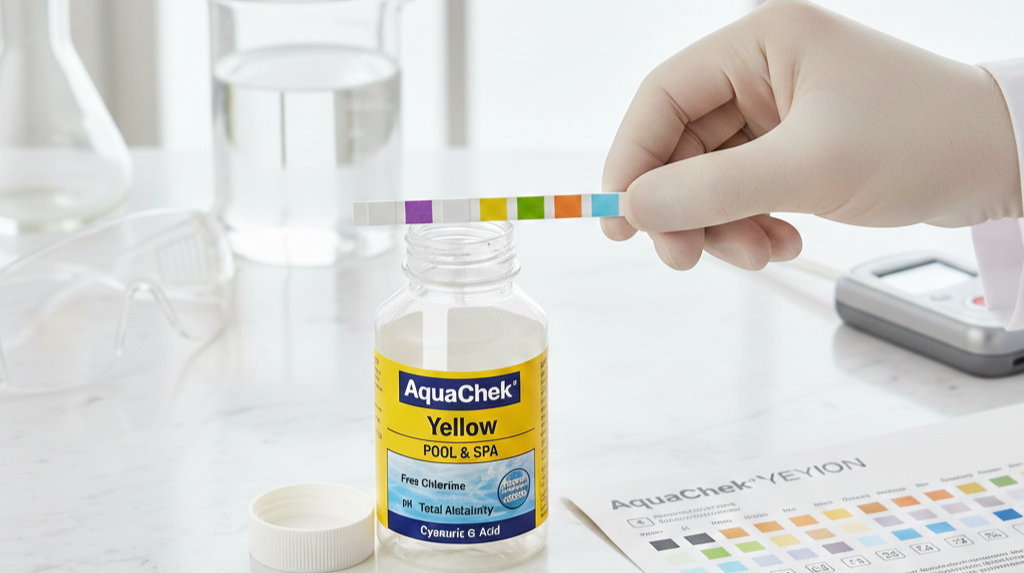
Water testing is not just a chore; it is pure chemistry in action. Whether you are maintaining a backyard pool or a hot tub, guessing the chemical balance of your water is a recipe for disaster. Skin irritation, cloudy water, and bacterial growth are all direct results of poor chemical management.
As a chemist, I am constantly asked about the most efficient ways to test water at home without needing a full laboratory setup. Today, I am analyzing one of the most popular products on the market. In this comprehensive guide, we will look at the science behind the strips to see if they are actually worth your money.
The Importance of Chemical Accuracy in Water
Starting this AquaChek Yellow Review, the first thing we need to discuss is why chemical accuracy matters so much. Water is a universal solvent, meaning it constantly interacts with everything it touches, including human skin and sanitizing agents.
When pool or spa water is unbalanced, the sanitizers (like chlorine) become completely ineffective. For example, if the water is too acidic, the chlorine burns off too rapidly. If it is too basic, the chlorine becomes locked and unable to kill bacteria. This is why a reliable testing method is not just optional—it is a health and safety requirement.
Breaking Down the 4 Testing Parameters
In any thorough AquaChek Yellow Review, it is vital to understand exactly what these strips are measuring. This specific 4-way strip tests for four critical chemical parameters:
1. Free Chlorine: This is the active, killing form of chlorine (Hypochlorous acid) available to sanitize your water. Unlike “Total Chlorine,” which includes spent or “dead” chlorine, Free Chlorine tells you exactly how much active chemical is ready to destroy bacteria.
2. pH Levels: pH measures the concentration of hydrogen ions in your water on a logarithmic scale. A perfect pool pH is between 7.4 and 7.6, which exactly matches the pH of human eyes and mucous membranes. This prevents irritation.
3. Total Alkalinity: Think of alkalinity as the “bodyguard” for your pH. It measures the carbonates and bicarbonates in the water. Without proper alkalinity, your pH levels will fluctuate wildly every time it rains or someone enters the water.
4. Cyanuric Acid (Stabilizer): Chlorine degrades rapidly under UV sunlight. Cyanuric acid acts as a chemical sunscreen for your chlorine, preventing the sun from destroying your active sanitizer.
| Chemical Parameter | Ideal Range | What Happens if it’s TOO LOW? | What Happens if it’s TOO HIGH? |
| Free Chlorine | 1.0 – 3.0 ppm | Bacteria and algae growth | Skin/eye irritation, bleached swimsuits |
| pH Levels | 7.4 – 7.6 | Corrosive water, eye burn | Cloudy water, scaling, “locked” chlorine |
| Total Alkalinity | 80 – 120 ppm | pH levels bounce wildly | Cloudy water, hard to adjust pH |
| Cyanuric Acid | 30 – 50 ppm | Chlorine is destroyed by the sun | Chlorine becomes ineffective (Chlorine Lock) |
How Colorimetric Test Strips Actually Work
A fascinating part of this AquaChek Yellow Review is the actual mechanism of the strips. How does a piece of paper tell you complex chemical values? The answer is colorimetric analysis.
Each pad on the test strip is treated with specific chemical reagents. When these reagents react with the water molecules, an oxidation-reduction (redox) reaction or an acid-base reaction occurs, resulting in a color change. The intensity of this color directly correlates to the concentration of the chemical in the water. While not as precise as a digital photometer used in a professional lab, the reagent chemistry used by AquaChek is highly calibrated for home accuracy.
Common Mistakes Users Make (And How to Avoid Them)
Throughout my research for this AquaChek Yellow Review, I noticed many 1-star complaints online that are actually caused by user error, not a faulty product. As a chemist, I must point out the correct methodology for testing.
First, never dip the strip directly into the top layer of the water. The surface water interacts with the air and oils and does not represent the true chemical balance. Always reach your arm about 18 inches (elbow-deep) into the water to get a proper sample.
Second, do not shake the strip violently after dipping it. Shaking it can cause the wet chemical reagents from one pad to bleed onto another pad, creating a mixed reaction and a false color reading. Simply dip it, pull it out level, wait exactly 15 seconds, and read the results in natural daylight. Artificial indoor lighting can distort how your eyes perceive the colors on the chart.
Pros and Cons from a Laboratory Perspective
To keep this AquaChek Yellow Review completely objective, let’s weigh the advantages and the chemical limitations of this specific kit.
The Pros:
- Unbeatable Speed: You get a full chemical profile in just 15 seconds. Liquid drop kits take significantly longer to mix and read.
- Ease of Use: There is no counting drops, no mixing hazardous reagent bottles, and no complicated math.
- Reliable Reagents: AquaChek is a well-established brand in the chemical testing industry. Their reagent pads are consistently manufactured, meaning batch-to-batch variation is very low.
The Cons:
- Subjective Reading: Because you are matching colors with your naked eye, slight variations in color perception can occur from person to person.
- Moisture Sensitivity: If you leave the bottle open and humidity gets inside, the ambient moisture will prematurely react with the chemical pads, ruining the entire batch.
Final Verdict: Should You Buy It?
Concluding this AquaChek Yellow Review, my professional opinion is a strong yes—with a small caveat.
If you manage a public commercial pool, you need a digital testing kit for legal compliance. However, for 95% of residential pool and hot tub owners, the AquaChek Yellow 4-Way strips are the absolute best balance of speed, affordability, and scientific accuracy.
They provide a fast, reliable snapshot of your water’s chemistry, allowing you to make quick adjustments before a small chemical imbalance turns into a massive algae bloom. Just remember to keep the cap tightly closed to protect those sensitive chemical reagents!
[Insert Your Amazon Affiliate Link Here: Check the Latest Price for AquaChek Yellow]