
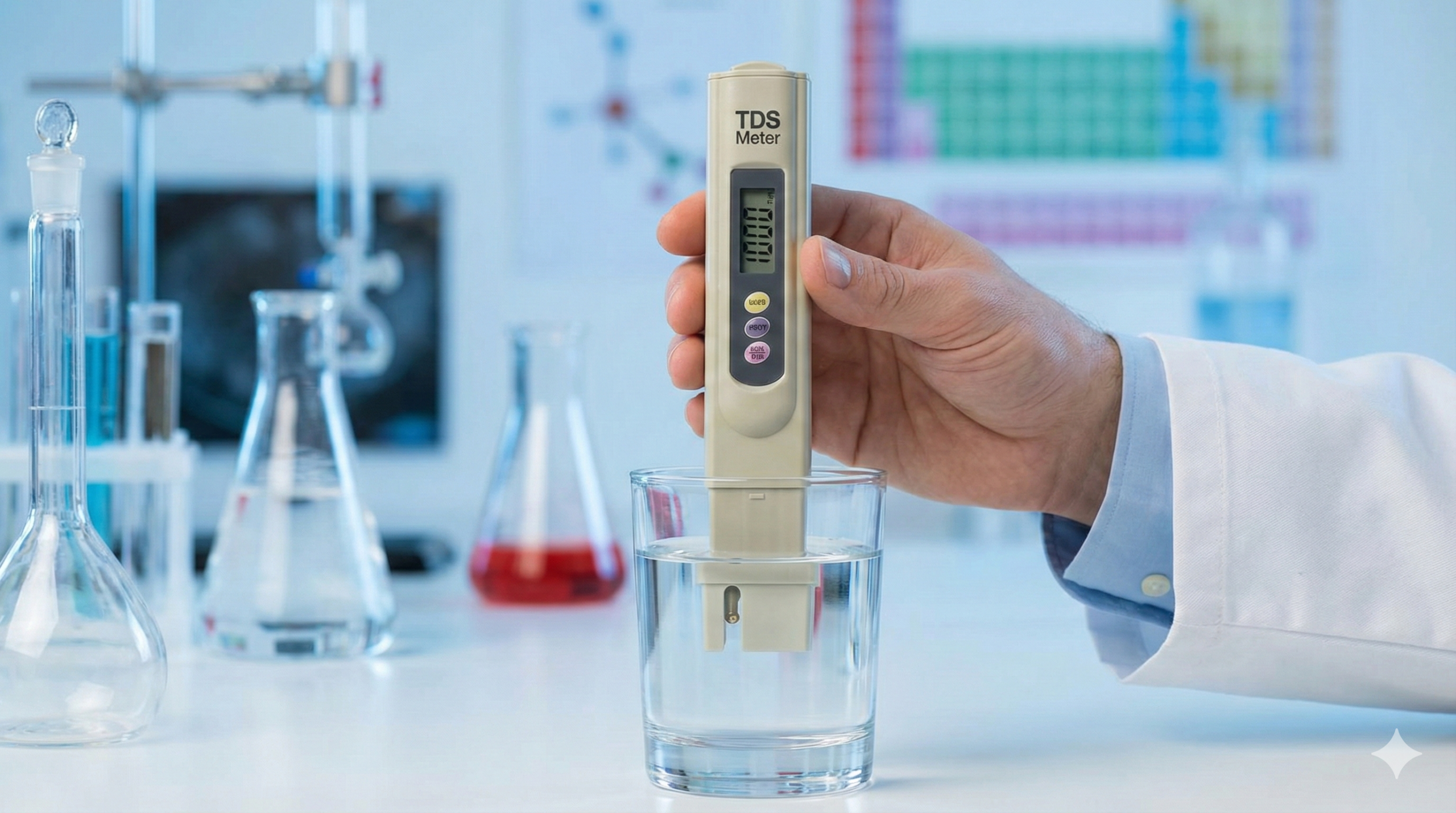
You bought a cheap digital meter online, dipped it into a fresh glass of your home tap water, and the screen immediately flashed a surprisingly large number. Panic sets in instantly. Does a high TDS reading mean your water is heavily contaminated? Is it truly safe for your family to drink, or should you immediately stop using your tap?
As a chemist, I encounter this specific misunderstanding almost every single day. Water filtration companies often use these simple meters as a scare tactic to convince you to purchase expensive reverse osmosis systems. But the actual science behind water chemistry tells a completely different story. Today, we are going to break down exactly what that number on your digital screen represents, what it completely fails to measure, and why a high TDS reading does not automatically indicate that your water is dirty or dangerous to consume.
What Exactly is TDS? (The Chemistry Explained)
To understand why you might be seeing a high TDS reading, we first need to define the term. TDS stands for Total Dissolved Solids. In the realm of chemistry and water quality, this metric represents the total concentration of all dissolved substances present in your water. This broad category includes a wide variety of inorganic salts—such as calcium, magnesium, potassium, sodium, bicarbonates, chlorides, and sulfates—alongside small trace amounts of dissolved organic matter. As rainwater travels through the earth, over rocks, and into aquifers, it acts as a universal solvent, picking up minerals along the way. Therefore, a high number is often just a natural reflection of the geological journey your water has taken.
How Your Meter Actually Calculates a High TDS Reading
Here is the fundamental scientific truth that many consumers do not realize: those inexpensive handheld testing meters do not actually count the physical particles floating in your water. Instead, they measure electrical conductivity (EC). Pure H2O is, in fact, an incredibly poor conductor of electricity. However, when minerals and mineral salts dissolve into the water, they break down into positively and negatively charged ions. The greater the number of these ions present in the liquid, the better the water conducts an electrical charge. The meter sends a tiny electrical current through the water, measures the resistance, and uses a mathematical conversion formula. Ultimately, a high TDS reading simply means your water is highly conductive due to these dissolved ionic compounds.
Common Causes of a High TDS Reading in Tap Water
In the vast majority of municipal water supplies, a high TDS reading simply indicates that your water is “hard” or richly infused with naturally occurring minerals. In many instances, the exact same minerals causing your water to test high are the ones found in premium, expensive bottled mineral waters. Calcium and magnesium, for example, are not only harmless but are actually essential nutritional elements for human health. Furthermore, these specific minerals give drinking water a crisp, refreshing taste. If you were to drink perfectly pure, laboratory-grade distilled water, you would find that it tastes incredibly flat and dull. Therefore, discovering a high measurement of 200 ppm or 300 ppm is often completely normal and perfectly safe for daily drinking.
Comparing Typical Water Sources and Your High TDS Reading
To give you a better perspective on your high TDS reading, it is highly helpful to look at standard measurements across different types of water sources. The comparison table below illustrates the typical ranges you can expect to see on your meter.
| Water Source | Typical TDS Range (ppm) | What This Means for Your Water Quality |
| Distilled / RO Water | 0 – 10 ppm | Extremely pure, lacks minerals, flat taste. |
| Spring / Purified Water | 50 – 150 ppm | Ideal balance of minerals for drinking and coffee brewing. |
| Average City Tap Water | 150 – 400 ppm | Standard range; mostly benign calcium and magnesium. |
| Premium Mineral Water | 300 – 600+ ppm | Intentionally high in dissolved solids for health and taste. |
| EPA Maximum Level | 500 ppm | The secondary (non-enforceable) standard for aesthetics. |
The Hidden Dangers a High TDS Reading Cannot Detect
This is precisely where relying solely on a cheap digital meter becomes a dangerous game. Because these meters are only capable of measuring electrical conductivity, they are completely blind to uncharged molecules, biological contaminants, and highly toxic compounds that exist in trace amounts. A high TDS reading does not mean your water is toxic, but conversely, a low reading does not mean your water is safe from invisible threats.
Heavy Metals, Chemicals, and Your High TDS Reading
Toxic heavy metals such as lead, arsenic, or mercury are incredibly dangerous to human health even at microscopic levels (measured in parts per billion, not million). A lethal, highly dangerous amount of lead leaching from old city pipes into your water supply would not noticeably increase your conductivity, meaning it would not trigger a high TDS reading. Furthermore, these basic meters are entirely incapable of detecting agricultural pesticides, industrial herbicides, pharmaceutical residues, municipal chlorine, chloramines, volatile organic compounds (VOCs), or PFAS (forever chemicals).
Microorganisms and the Illusion of a High TDS Reading
Similarly, biological threats operate completely independently of dissolved mineral salts. Microorganisms, dangerous bacteria like E. coli, microscopic viruses, and intestinal parasites carry no electrical charge whatsoever. You could theoretically test a glass of water, be thrilled that it doesn’t show a high TDS reading (perhaps scoring a “perfect” 10 ppm), yet that same water could be teeming with dangerous pathogens that will make you severely ill. The meter simply cannot see them.
Do Shower Filters Actually Fix a High TDS Reading?
A very common, frustrating complaint I see from readers is that they install a brand-new, high-quality shower filter, test the resulting water with their meter, and get angry when they still see a high TDS reading. As explained throughout this article, high-quality shower filters are simply not designed to remove dissolved mineral salts. Instead, they utilize specialized media like KDF-55, calcium sulfite, and activated carbon to chemically neutralize chlorine and physically trap VOCs. These harmful, skin-drying chemicals don’t significantly impact electrical conductivity anyway. If you are looking for a filter that actually protects your skin, hair, and respiratory system from harsh chemical vapors rather than just chasing a meaningless number, you should read my detailed comparison between the AquaBliss SF100 and SF500 shower filters where I break down the exact filtration stages and advanced chemistry of each specific model.
Conclusion: The Real Meaning of Your High TDS Reading
In conclusion, you absolutely do not need to throw your testing meter away, but you must fundamentally understand its severe limitations. A digital meter is a fantastic, highly useful tool for checking the ongoing performance of a Reverse Osmosis (RO) membrane or dialing in the absolute perfect water profile for brewing third-wave specialty coffee. However, a high TDS reading is absolutely not a definitive water safety test. If you are genuinely concerned about the purity, health, and overall safety of your home’s tap water, skip the misleading handheld gadgets. Instead, send a physical water sample to a certified laboratory for a comprehensive, scientific analysis. That is the only true way a chemist would verify water quality.
Recommended Water Testing Kits and Filters (Where to Buy)
If you are still concerned about your water quality after getting a high TDS reading, investing in a comprehensive laboratory water testing kit or a scientifically proven filtration system is the best step you can take. While cheap digital meters only tell a fraction of the story, professional-grade solutions provide real safety and peace of mind for your family.
[The purchase links will be here soon!]